 Amiga Hardware Database
Manufacturer “Memory and Storage Technology”
9 expansions in database
Manufacturer Memory and Storage Technology, Australia | Date 1991 | Amiga any Amiga | Interface RGB port |
- external framebuffer
- screenmodes of NTSC version:
- 320×200, 384×240, 320×400, 384×480 with 1-8, 12, 15, 18, 24, 48 bits
- 640×200, 768×240, 640×400, 768×480 with 1-8, 12, 15, 18, 24 bits
- screenmodes of PAL version:
- 320×256, 384×296, 320×512, 384×580 with 1-8, 12, 15, 18, 24, 48 bits
- 640×256, 768×296, 640×512, 768×580 with 1-8, 12, 15, 18, 24 bits
- the 48 bit mode means a 24 bit image with a 24 bit overlay
- plugs into the 23 pin video port - it uses the four digital signals intended for digital TTY monitors (red, green, blue and intensity) to transfer image data to the board from Chip RAM
- 1.5 MB display memory (12 ZIPs)
- can store up to four 24 bit colour frames at once
- realtime animation of 4096 colour frames
- the ColorBurst memory can be written by the Blitter
- realtime horizontal and vertical scrolling
- dynamic Amiga graphics overlay
- supported fileformats: IFF24, IFF21, RGB8, TIFF, REND
- when not displaying 24 bit images, it passes through the normal Amiga video
- compatible with flicker-fixers but may have problems with certain genlocks (the Video Toaster requires modifications in order to work with the ColorBurst)
- an 5" × 2" × 8" unit with internal cooling fan
- power and activity indicator lights
- external power supply
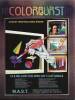
Advert (AU)
1991-05
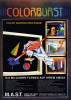
Advert (DE)
1991-06
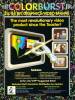
Advert (US)
1991-08
Advert (AU)
1991-08
Advert (US)
1991-09

Advert (AU)
1991-12

Advert (AU)
1992-03
Manufacturer Memory and Storage Technology, Australia | Date 1989 | Amiga A2000, A3000, A4000 | Interface Zorro II | Autoconfig ID 32768 / 8 |
- SCSI controller
- uses DMA transfers
- place for a 3.5" hard disk on the card but no power connector is mounted on the board
- autoboot ROM - autobooting requires Kickstart 1.3
- autoboot disable switch
- two 50 pin internal headers
- DB25 external connector
- three status LEDs to indicate proper functioning of autoconfigure, board select and DMA access
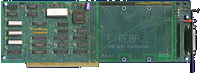
front side
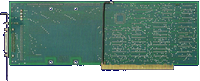
back side
- Fireball-04.bin
Boot ROM
fireball.device v0.4
8 kB
Advert (DE)
1990-05
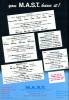
Advert (DE)
1990-10

Advert (DE)
1990-10
Manufacturer Memory and Storage Technology, Australia | Date 1992 | Amiga A2000, A3000, A4000 | Interface Zorro II | Autoconfig ID 32768 / 4,7 |
- SCSI Controller
- provides SCSI and RAM on a Zorro II card and is a commercial version of the public domain kitware Scram 2000
- this card differs in details from the public domain version, e.g. in different silkscreen and a different autoboot ROM (flash16.device)

front side
Advert (AU)
1991-08
Advert (US)
1991-09
Advert (AU)
1991-12
Advert (AU)
1992-03

Advert (AU)
1993-01
Manufacturer Memory and Storage Technology, Australia | Date 1991 | Amiga A500 | Interface side expansion port | Autoconfig ID 4096 / 3,4 |
- No description available.
Do you own this expansion, or have information about it? Please let us know.
Advert (AU)
1991-12
Manufacturer Memory and Storage Technology, Australia | Date 1990 | Amiga A500 | Interface trapdoor slot, Gary socket |
- provides a total of 2.5 MB Chip RAM using bank-switching technique
- works with 1 MB Fat Agnus and Kickstart 1.3 only
- bank-switching is realized by software - blocks of memory can be switched between Chip and Fast RAM (or disabled) anytime, except for every vertical sync pulse
- sixteen DIP sockets filled with 2 MB RAM
- uses 256k×4 DIPs
- the main board connects to the trapdoor slot
- an adaptor board connects to Gary's socket
- battery backed up clock
Advert (DE)
1990-05
Manufacturer Memory and Storage Technology, Australia | Date 1989 | Amiga A500 | Interface side expansion port |
- 512 kB RAM
- four socketed 256k×4, 100 ns DIPs
- connects to the trapdoor slot
- 3 volt Lithium battery backed up clock
- disable switch

Advert (GB)
1989-04
Manufacturer Memory and Storage Technology, Australia | Date 1989 | Amiga A500, A1000 | Interface side expansion port |
- Memory Expansion
- sixteen DIP sockets for up to 2 MB FastRAM
- accepts 256k×4 DIPs in groups of four
- DIP chips are soldered in due to the small form factor
- possible configurations are 0.5, 1 or 2 MB
- zero wait states
- connects to the side expansion port, no passthrough connector
- two different versions for A500 and A1000 (flat or upright housing)
- green autoconfig/power LED
- memory access indicator, dubbed "RAM tachometer" (red LED)
- disable switch
- RAM Locations / Jumper Settings
| Memory | Locations | Jumper JP1 |
| 512K | U4, U8, U12, U16 | not set |
| 1M | U3, U4, U7, U8, U11, U12, U15, U16 | left position (towards 74LS125) set, right position not used |
| 2M | all locations | left and right positions set |
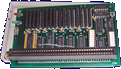
A1000 version, opened, front side
- Minimegs.pdf
Installation Instructions
567 kB
Advert (GB)
1989-04
Advert (US)
1991-09
Advert (AU)
1991-12
Manufacturer Memory and Storage Technology, Australia | Date 1989 | Amiga A2000, A3000, A4000 | Interface Zorro II |
- the board is basically a SupraRAM 2000 distributed by Memory and Storage Technology
- the Supra title is just covered with a MAST sticker.
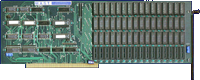
front side
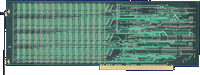
back side
Advert (DE)
1990-10
Advert (DE)
1990-10
Manufacturer Memory and Storage Technology, Australia | Date 1989 | Amiga any Amiga | Interface parallel port |
- SCSI adapter
- converts the parallel port signals to SCSI signals
- connects to the parallel port and provides a DB25 SCSI connector - the parallel port is passed through
- very slow - the parallel port limits the data transfer
- cannot autoboot
- place for a 3.5" hard disk inside the case
- DIP switches for write protection, automatic power-on and SCSI address
- does not work with processor cards with 32 bit RAM or CPU caches turned on - turning them off is sufficent
Advert (GB)
1989-04
Advert (DE)
1990-05