 Amiga Hardware Database
Search Result
8 expansions found
Manufacturer Individual Computers, Germany | Date 2008/2009 | Amiga A1200, A4000, CD32 | Interface Lisa chip |
- flicker-fixer
- with a maximum input pixel clock of 28 MHz, all Amiga video modes up to Super Hires are supported and flicker-fixed (with the exception of the A2024 mode)
- picture refresh rate of at least 60 Hz for all screen modes, resulting in a maximum output pixel clock of 71 MHz
- 24 bit color support (16.7 million colors)
- supports interlaced and progressive scan input modes
- output modes are always progressive scan
- two output modes can be chosen:
- Async mode: output pixel clock of Amiga modes are multiplied 2.5 times
- Vertical Sync mode: exact double of Amiga mode pixel clock (eliminates tearing effects)
- clips only onto the Lisa chip on motherboard, no soldering required
- gets power and all signals from this chip
- sync signals are derived from the inter-chip communication of the AGA chipset
- HD15 VGA connector
- supports border blanking
- 16 megabyte SDRAM
- SDRAM is single-ported, thus reading and writing is decoupled by two FIFO buffers and a dual-port SDRAM controller running at 111 MHz
- only 12 MB are used, 4 MB stay free
- memory layout of 2048x2048 pixels (= maximum resolution)
- compatible to Genlocks
- no passthrough mode (all resolutions are flicker-fixed)
- FPGA based design with FlashROM
- Emergency Mode (emergency disk needed) in case a FlashROM update went wrong
- low heat dissipation due to 2.5V/3.3V design (only the voltage regulator is 5V)
- boot screen, shown for a pre-defined time - in case important information is displayed (e.g. Guru / Error Screen, Early Startup Menu), this time is reduced
- no driver needed, however additional screenmodes are supported:
- HighGFX (1024×786)
- HD720 (1280×720)
- Indivision AGA 1200
- cutouts in the board allow installation of other internal A1200 components like IDE-Fix Express and the Lyra 1200 keyboard adaptor - tight design, so boards may touch on certain A1200 board revisions
- first revision boards were prone to snapping from the Lisa socket, so later revisions had the socket on the Indivision board machine finished
- Indivision AGA 4000
- this is a follow-up design to the Indivision AGA 1200, offering the same features while having a different board layout to fit in A4000D and CD32
- 10nF capacitors have been added to the PLLs
- two (instead of one) TTL drivers for the VGA Sync wires
- prototype board is white, the final version has a blue PCB
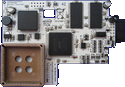
Indivision AGA 4000 Prototype Board, front side
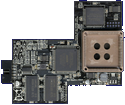
Indivision AGA 1200, front side
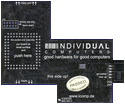
Indivision AGA 1200, back side
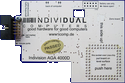
Indivision AGA 4000 Prototype Board, back side
Manufacturer Individual Computers, Germany | Date 2012/2013 | Amiga A1200, A4000T, A4000, CD32 | Interface Lisa chip |
- flicker-fixer
- all Amiga video modes up to Super Hires are supported and flicker-fixed (with the exception of the A2024 mode)
- picture refresh rate of at least 60 Hz for all screen modes, resulting in a maximum output pixel clock of 71 MHz
- 24 bit color support (16.7 million colors)
- supports interlaced and progressive scan input modes
- output modes are always progressive scan
- two output modes can be chosen:
- Async mode: output pixel clock of Amiga modes are multiplied 2.5 times
- Vertical Sync mode: exact double of Amiga mode pixel clock (eliminates tearing effects)
- clips only onto the Lisa chip on motherboard, no soldering required
- gets power and all signals from this chip
- sync signals are derived from the inter-chip communication of the AGA chipset
- DVI-I connector
- supports border blanking
- 16 megabyte SDRAM
- SDRAM is single-ported, thus reading and writing is decoupled by two FIFO buffers and a dual-port SDRAM controller running at 111 MHz
- only 12 MB are used, 4 MB stay free
- memory layout of 2048x2048 pixels (= maximum resolution)
- compatible to Genlocks
- no passthrough mode (all resolutions are flicker-fixed)
- FPGA based design with FlashROM
- Emergency Mode (emergency disk needed) in case a FlashROM update went wrong
- low heat dissipation due to 2.5V/3.3V design (only the voltage regulator is 5V)
- boot screen, shown for a pre-defined time - in case important information is displayed (e.g. Guru / Error Screen, Early Startup Menu), this time is reduced
- no driver needed, however additional screenmodes are supported:
- HighGFX (1024×786)
- HD720 (1280×720)
- Xtreme (1280×1024)
- SuperPlus (800×600)
- config tool provided to update flash memory and make adjustments to the output
- the socket on the board had to be machined to fit properly on the Lisa chip
- compared to the predecessor, the board features a faster FPGA, faster memory and more flexible pixel clocks - however the main features stay the same
- Indivision AGA MK2 1200 / A4000T (2012)
- DVI connector is located on a small PCB
- Indivision AGA MK2 4000 / CD32 (2012)
- DVI connector is located on a small PCB
- has a different board layout to fit in A4000D and CD32, but has the same features as Indivision AGA MK2 1200 / A4000T
- Indivision AGA MK2cr 1200 / A4000T (2013)
- cost reduced version:
- the components from the auxiliary PCB were moved to the Indivision board
- custom made DVI-I connector (molded type) connects to the board
- doesn't fit into the A4000T without modification: due to the changed connector for the DVI ouput, the board interferes with the electrolytic capacitor CE164C in the A4000T - this has to be replaced by a lower profile ceramic type to be able to fit the board
- custom tooling for the socket pins results in a firmer hold on the Lisa chip
Manufacturer ACT Elektronik, Germany | Amiga any Amiga | Interface RGB port |
- flicker fixer
- doubles the horizontal frequency of all 15 kHz screen modes to 31.5 kHz - other screen modes are passed through
- removes flicker of interlaced screens
- connects externally to the 23 pin RGB port
- being an external unit, it has to encode the RGB signal, flicker fix, split to RGB and sync again - this reduces the quality of the video signal
- sync delay adjustment potentiometer
- claimed to be compatible with the Video Toaster and all genlocks, but it's not in many cases - the genlocked video signal is passed through without scandoubling
- scandoubled screens are much draker than passthroughed screens
- high power consumption - the screen may go darker when the floppy drive is accessed
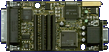
Board, front side
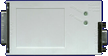
Case, top side
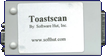
Case, bottom side
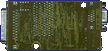
Board, back side
Manufacturer MicroniK, Germany | Date 1998 | Amiga any Amiga | Interface RGB port |
- scan doubler
- doubles the horizontal frequency of all 15 kHz screen modes (Hires, Lores, Super-Hires, Euro36), all other modes (including Super72) are passed through
- supports the AGA chipset
- connects externally to the 23 pin RGB port
- HD15 VGA connector
- provides lower quality video signal than the internal version (Scandy)
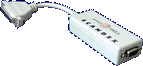
front side
Manufacturer MicroniK, Germany | Date 1998 | Amiga A1200 | Interface special (see text) |
- scan doubler
- doubles the horizontal frequency of all 15 kHz screen modes (Hires, Lores, Super-Hires, Euro36), all other modes (including Super72) are passed through
- clips onto some chips of the A1200 motherboard, no soldering required
- HD15 VGA connector
Manufacturer DCE, Germany | Date 1998 | Amiga any Amiga | Interface RGB port |
- flicker fixer
- doubles the horizontal frequency of PAL, ECS and Euro36 screen modes to 31.5 kHz
- removes flicker of interlaced screens
- cannot handle Super72
- connects externally to the 23 pin RGB port - it needs about 6 inches of space behind the Amiga
- being an external unit, it has to encode the RGB signal, flicker fix, split to RGB and sync again - this reduces the quality of the video signal slightly producing some vertical banding through solid colours and a blinking effect when moving solid objects around the screen
- sync delay adjust switch
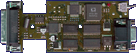
front side
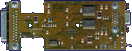
back side
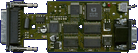
front side
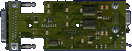
back side
Manufacturer DCE, Germany | Date 1998 | Amiga A1200, A4000 | Interface special (see text) |
- flicker fixer / scandoubler
- doubles the horizontal frequency of PAL, ECS and Euro36 screen modes to 31.5 kHz
- cannot handle Super72
- two versions existing
- flicker fixer: equipped with field memory chips (two large chips in the middle of the board), removes flicker of interlaced screens
- scan doubler: no field memory chips, does not remove flicker
- connects internally onto the top of the Lisa chip
- attaches with a ribbon cable to the external DB23 to HD15 VGA adapter

front side

back side

connector board, front side
- ScanMagic_A1200.pdf
A1200 installation manual (german)
1161 kB - ScanMagic_A4000.pdf
A4000 installation manual (german)
934 kB
Manufacturer Cabletronic, Italy | Date 1996 | Amiga any Amiga | Interface RGB port |
- scandoubler
- doubles the horizontal frequency of the PAL screen mode to 31.5 kHz (all other modes are passed through)
- supports up to 15 bit colour depth (32768 colors)
- connects externally to the 23 pin RGB port and offers a HD15 VGA output
- gets power from the RGB port, thus a weak power supply can cause flickering (for example during floppy accesses)
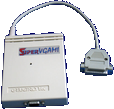
front side
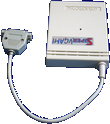
rear side
- SVGAMI.pdf
user manual (german)
19 kB