 Amiga Hardware Database
Search Result
5 expansions found
Manufacturer Heifner Communications, USA | Date 1993 | Amiga A2000, A3000, A4000 | Interface video slot |
- No description available.
Do you own this expansion, or have information about it? Please let us know.
Advert (US)
1993-02
Manufacturer NewTek, USA | Date 1993 | Amiga A2000, A3000, A4000 | Interface Zorro II |
- Video Toaster controller
- a SCSI based remote controller that allows Video Toaster to be used as a peripheral for an Apple Macintosh
- as several TV stations and video production companies have experience only with Macs, NewTek had a demand for a Toaster to Mac interface system
- the system consists of the Amiga interface card, the controller software on the Macintosh, and a simple SCSI cable
- the controller software allows the use of Mac OS based image- and video processing applications instead of ToasterPaint, provides a Mac like user interface for the Video Toaster Switcher, and provides file transfers to and from the Amiga
- the interface card is manufactured by Expansion Systems, it's basically a modified version of their DataFlyer Plus SCSI card
- AMD 5380 SCSI controller
- DB25 external SCSI connector
- modified "autoboot ROM" and PALs
- SCSI ID selector jumpers in place of DataFlyer's IDE header
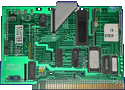
front side
- ToasterLink_Flyer.pdf
Flyer
1013 kB
Manufacturer NewTek, USA | Date 1990 | Amiga A2000, A3000, A4000 | Interface video slot | Autoconfig ID 2191 / 0 |
- combination of a video switcher, a genlock, a framebuffer and special effects device
- 4× composite inputs (BNC)
- 2× composite outputs (BNC) - Preview and Program
- Input 1 is used to time all the signals to - although the Toaster has its own sync generator, it is recommended to connect a stable external video source here
- requires time base corrected video sources
- stricly a composite device - it works exclusively with composite video signals internally
- NTSC only
- the Video Toaster won the Emmy Award, the broadcast industry's most prestigious award
- still-store
- 2 MB dual frame buffer can hold two 768×400 images in 24 bit
- stores images freezed from incoming video
- digital video effects from one stored image to another
- genlock
- encodes Amiga RGB to composite video
- overlays and dissolves graphics or video on any input source
- Luminance Keyer - allows the superimposing of an actor in front of a background or fly text over video
- software
- Switcher:
- controls the inputs, framebuffer, framegrabber and serves as a launcher for the other Toaster applications
- four banks of digital video effects with over 300 combinations and transitions: flips, tumbles, pulls, spins, smooth fades, standard wipes, transparent cast shadows, synchronized sound effects, positionable windows and one hundred color process effects
- requires at least 3 MB Fast RAM and 1 MB Chip RAM
- ToasterCG:
- 35 ns character generator
- capable of generating up to 100 pages of text using any of the 100 postscript fonts included
- creates titles with scrolls, crawls, graphics, gradient blends, variable transparency and font scaling from 10-400 lines high
- ToasterPaint:
- 24 bit painting
- the interface uses a standard Amiga screen in HAM mode, 768×400 is achieved as a virtual canvas
- image information is maintained inetranally as 24 bit data and can be displayed anytime in 24 bit with the still-store
- LightWave 3D
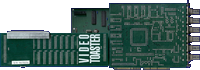
front side
Advert (US)
1991-07
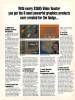
Advert (US)
1991-07
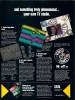
Advert (US)
1991-07
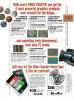
Advert (US)
1991-08

Advert (US)
1991-08
Advert (US)
1991-10
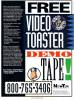
Advert (US)
1991-11
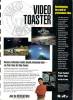
Advert (US)
1993-02
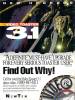
Advert (US)
1994-02
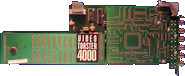
Manufacturer NewTek, USA | Date 1993 | Amiga A4000 | Interface video slot |
- successor of the Video Toaster
- when installed in the A4000:
- works much faster than the original Video Toaster and gives A4000 specific features
- full AGA support and new effects particular to the AGA mode
- nine banks of digital video effects
- plugs into the video slot but takes up the space of the Zorro slot above it
- when installed in the A2000 or A3000:
- works slower than the original Video Toaster
- six banks of digital video effects
- triple frame buffers
- the input and output BNC connectors are placed on a removable board - separate versions for A2000 / A3000 / A4000 cases
- new features of v3.0 software
- Character Generator
- Compugraphic and Type 1 font support
- automatic kerning
- over 300 fonts included
- LightWave: animations can be recorded in realtime from the switcher
- new features of v4.1 software
- Switcher
- 600 effects
- customizable interface
- drag and drop effects, CG pages, control elements, Flyer video clips
- Project Editor
- allows building a new switcher, creating slide shows with still stores and effects
- intuitive drag and drop storyboard
- Character Generator
- realtime scaling PostScript brushes, gradient fonts
- realtime display of brushes
- spell checker
- expanded ARexx port
- Toaster Paint
- full screen painting
- support for Flyer clips for rotoscoping, filters and special effects
- global flood fill mode
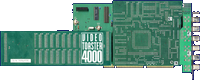
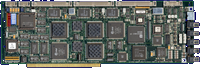
front side
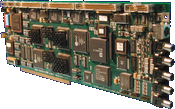
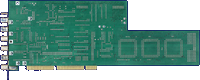
back side
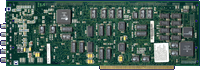
back side

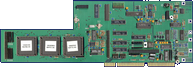
Line board, front side
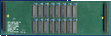
Main board, front side
RAM board, front side
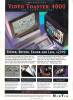
Advert (US)
1993-08
Manufacturer NewTek, USA | Date 1994 | Amiga A2000, A3000, A4000 | Interface Zorro II |
- NTSC only non-linear editing system
- broadcast quality, tapeless nonlinear editing system for the Video Toaster and Video Toaster 4000
- requirements:
- Video Toaster with v4.1 software
- a SCSI 2 drive for Lightwave recording
- three SCSI 2 drives for A/B roll editing - two for video, one for audio
- input from video tapes must be time base corrected
- compresses and plays back video in realtime
- true broadcast quality - 60 fields per second, full overscan 752×480
- internally works with D2 data - no D2 / composite transcoding
- proprietary coporession method: Video Toaster Adaptive Statistical Coding (VTASC):
- relies on limiting the video signal (i.e. dropping to Beta SP quality) instead of lowering picture quality as do JPEG, MPEG, WaveLet
- no visible pixelization, artifacts show as video "noise" instead of jpeg "blockiness"
- by using faster drives, lossless D2 quality can be achieved
- three SCSI buses (two for video, one for audio), each bus can handle 7 SCSI drives (21 total)
- two serial ports to control serial-capable VTRs
- the SCSI and serial ports can be routed outside of the computer with the so called Octopus cable
- video:
- video input to the Flyer is provided via the connecting internal ribbon cable from the Toaster, as is video output
- 14.3 MHz sampling rate
- 8 bit quantizing
- 8 MB buffer
- audio recorder / mixer:
- ADSP2115
- digital inputs
- video disk A and B, left and right
- audio disk A and B, left and right
- analog, unbalanced left and right RCA inputs and outputs on the card's backplane
- 64 kB memory
- 20 MHz clock rate
- 16 bit sampling at 44.1 kHz
- 64x oversampling ratio A/D converter