 Amiga Hardware Database
Search Result
2 expansions found
Manufacturer Great Valley Products, USA | Date 1989 | Amiga A2000 | Interface CPU slot | Autoconfig ID 2017 / 8,9,13 |
- processor
- 68030 @ 16 / 25 / 28 / 33 / 50 MHz, PGA
- optional 68882 @ 16 - 50 MHz, PGA - can be clocked at different speed than the CPU
- optional memory daughterboards
- 68030-RAM8:
- eight 30 pin SIMM sockets accept 4 or 8 MB RAM
- supports only special 1 MB Nibble Mode SIMMs, they are more expensive than GVP SIMMs
- accepts SIMMs in groups of four
- 68030-RAM32: (from 1991)
- eight 64 pin SIMM sockets accept up to 8 or 20 MB RAM
- supports only special 1 or 4 MB, 60 ns GVP SIMMs
- 60 ns SIMMs are required for 50 MHz, 70 ns for 33 MHz, 80 ns for 25 MHz
- 16 - 33 MHz boards support 1 MB SIMMs only, possible configurations are 2, 4 and 8 MB
- 50 MHz boards support 4 MB SIMMs, possible configurations are 4, 8, 12, 16 and 20 MB
- using a 4 MB SIMM requires four 1 MB SIMMs to be installed in sockets 3 to 6, so the 4 MB SIMMs can only be installed into sockets 7 to 10
- optional IDE controller
- two autoboot ROM sockets
- to activate the IDE controller only the boot EPROM(s) (gvpat.device) has to be installed on the main board - the first version of the driver software required two EPROMs, later ones required only one
- does not support drives that has more than 1024 cylinders
- controller uses byte-swapped storaging, so the HDD will be unreadable on other controllers without that feature
- 40 pin internal IDE header
- A-Max II driver (gvpat.amhd) - requires gvpat.device v2.4 and A-Max v2.06
- notes
- autobooting requires at least Kickstart 1.3 - the autoboot ROM should not be installed with Kickstart 1.2
- two ROM sockets for UNIX boot ROMs that require an A2090A SCSI controller - these ROMs are compatible with those on the A2630
- 68000 fallback mode selectable by jumper
- the memory and IDE controller is also deactivated in fallback mode
- jumper settings - A3001
| Jumper | Default | Description |
|---|---|---|
| J4 | OPEN | Install to clock FPU from oscillator U2 |
| J5 | SHORTED | Remove to disconnect FPU from oscillator U1 |
| J6 | OPEN | Install to disable the 68030’s caches |
| J7 | OPEN | Install to disable the 68030’s MMU |
| J8 | OPEN | Install to enable Unix boot register |
| J9 | SHORTED | Remove to enable 68030 boot EPROMs |
| J10 | SHORTED | Remove for use in German 4-layer A2000’s |
| J11 | OPEN | Install to boot in 68000 mode |
| J12 | OPEN | Reserved |
| J13 | OPEN | Reserved |
| J14 | SHORTED | Reserved |
| J15 | OPEN | Reserved (AT interface) |
| J16 | SHORTED | Reserved (AT interface) |
- jumper settings - RAM8 board
| Jumper | Default | Description |
|---|---|---|
| J1 | OPEN | Reserved |
| J2 | OPEN | Reserved |
| J3 | SHORTED | Reserved |
| J4 | SHORTED | Reserved |
| J5 | SHORTED | Remove to enable full 8MB of 32-bit RAM |
| J6 | SHORTED | Reserved |
| J7 | OPEN | Reserved |
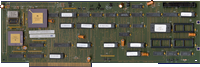
Series I, front side
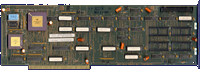
Series I, front side
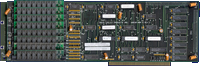
Series I with RAM8 board, back side
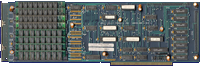
Series I with RAM8 board, back side
- A3001.dms
install disk (01.11.89)
320 kB - amiga.html#gvp
Ralph Babel
UNIX boot ROM image
1 kB - amiga.html#gvp
Ralph Babel
IDE ROM image
gvpat.device v4.1
10 kB
Advert (DE)
1989-10
Advert (DE)
1990-01
Advert (DE)
1990-05
Advert (DE)
1990-06
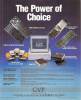
Advert (US)
1989-06
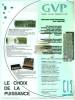
Advert (FR)
1989-09
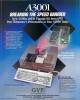
Advert (US)
1989-09
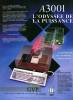
Advert (FR)
1989-12
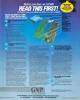
Advert (US)
1989-12
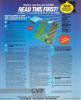
Advert (US)
1990-01
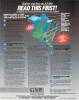
Advert (US)
1990-03
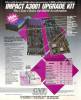
Advert (US)
1990-04
Advert (FR)
1990-05
Advert (FR)
1990-06
Advert (US)
1990-07

Advert (US)
1990-08
Advert (FR)
1990-09
Advert (FR)
1990-11
Advert (US)
1990-12
Advert (FR)
1990-12
Advert (US)
1991-04
Manufacturer Great Valley Products, USA | Date 1991 | Amiga A2000 | Interface CPU slot | Autoconfig ID 2017 / 8,9,13 |
- processor
- 68030 @ 33 / 50 MHz, PGA
- 68882 @ 33 / 50 MHz, PGA - clocked separately from the CPU
- memory daughterboard (68030-RAM32)
- eight 64 pin SIMM sockets accept up to 8 or 20 MB RAM
- supports only special 1 or 4 MB, 60 ns GVP SIMMs
- 60 ns SIMMs are required for 50 MHz, 70 ns for 33 MHz, 80 ns for 25 MHz
- 16 - 33 MHz boards support 1 MB SIMMs only, possible configurations are 2, 4 and 8 MB
- 50 MHz boards support 4 MB SIMMs, possible configurations are 4, 8, 12, 16 and 20 MB
- using a 4 MB SIMM requires four 1 MB SIMMs to be installed in sockets 3 to 6, so the 4 MB SIMMs can only be installed into sockets 7 to 10
- IDE controller
- autoboot ROM (gvpat.device)
- does not support drives that has more than 1024 cylinders
- autobooting requires at least Kickstart 1.3 - the autoboot ROM should be removed with Kickstart 1.2
- controller uses byte-swapped storaging, so the HDD will be unreadable on other controllers without that feature
- 40 pin internal IDE header
- A-Max II driver (gvpat.amhd) - requires gvpat.device v2.4 and A-Max v2.06
- jumper settings
- main board (rev 7):
J4
ON
OFFJ5
OFF
ON- FPU clock
- from oscillator U2
- from oscillator U1J10
ON
OFFJ12
ON
OFFJ13
ON
OFFJ14
OFF
ON- clocking mode
- A2000-A german motherboard, 68000 must be removed
- A2000-B motherboardJ6 - MMU: ON - disable J7 - CPU clock: OFF - 50 MHz, ON - lower J9 - 68030 Boot code EPROMS (U23 and U25): OFF - enable J11 - 68000 fallback mode: ON - enable J15 - IDE autoboot EPROM (U34): ON - enable J17 - IDE autoboot EPROM type: ON - 27256, OFF - 27128 J18 - IDE drive: OFF - connected (with autoboot EPROM v3 or later) J1, J16
ONJ2
OFF
- reserved - memory board (rev 3):
J3
OFF
ONCN11
OFF
2-3CN13
ON
OFF
- 50 MHz
- lower clockJ5
ON
OFF- memory address of CN7-CN10 SIMMs
- Zorro II address space (with 1 MB SIMMs only)
- 0x01000000 (with 4 MB SIMMs only)J1, J4, J6, J8
ONJ2, J11
OFFCN12
1-2
- reserved
- notes
- two ROM sockets for UNIX boot ROMs that require an A2090A SCSI controller - these ROMs are compatible with those on the A2630
- the memory and IDE controller is also deactivated in 68000 fallback mode
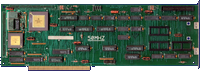
Series II, front side
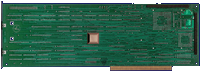
Series II, back side
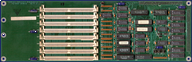
RAM32 board, front side
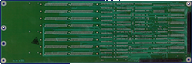
RAM32 board, back side
- amiga.html#gvp
Ralph Babel
UNIX boot ROM image
1 kB - amiga.html#gvp
Ralph Babel
IDE ROM image
gvpat.device v4.1
10 kB
Advert (US)
1991-05