 Amiga Hardware Database
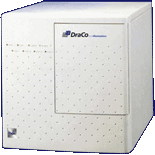

After the demise of Commodore in 1994, MacroSystem took a dim view of a successor company who could bring the Amiga back to success. Instead of waiting for the messiah they dropped the idea of developing the Zorro III version of V-Lab Motion and decided to develop an independent platform which could run Amiga OS and allowed easy adaptation of their Amiga non-linear video editing product line.
Processor, memory and chip set
68060 @ 50 or 66 MHz
up to 128 MB Fast RAM
The most unique technicality of DraCo is the absence of the Amiga custom chips. Agnus/Alice, Denise/Lisa, Paula and the others are all missing. So thus there's no need for Chip RAM as well. DraCo only kept two CIAs for its I/O ports and the Kickstart ROM for Amiga OS. Thanks to retargetable graphics, most well written Amiga software runs on it without hiccup.
Graphics
DraCo shipped with an Altais display card in one of its DraCo Bus slots. The card has the same features as the Retina BLT Z3, the screen modes are programmable through CyberGraphX from 320×240×24 to 1600×992×16.
Video and audio
When DraCo was released, the 32 bit V-Lab Motion card was not ready yet. They just put a Zorro II V-Lab Motion video and a Toccata audio card in till then.
Draco Motion combines all features of V-Lab Motion and Toccata, yet it uses entirely different components. It compresses and decompresses JPEG frames off-line for rendering, with selectable ratio of 3:1 - 50:1 from MovieShop. Image quality meets CCIR 601 4:2:2 standard 720×576 (PAL).
Expansion slots
3× DraCo Bus slots
5× Zorro II slots
Using Zorro III would have either required the presence of the Amiga custom chips or the development of a custom control logic. MacroSystem has chosen to create a simpler 32 bit bus, essentially a buffered 68040 bus with AutoConfig support, and call it DraCo Direct Bus. The specifications have never been officially published, so there are no cards made for it by third party developers. Only two cards were available from MacroSystem (Altais and Draco Motion). The third slot was meant for a real-time rendering card with a DEC Alpha processor on it, but never finished.
The Zorro II bus of DraCo runs at higher clock speed, giving about 1 MB/s extra over the standard Amiga Zorro II slots. It allows the 16 bit V-Lab Motion card to produce better quality video output, but makes many Zorro II expansion cards incompatible with the DraCo.
Interfaces
- Main board:
- 1× serial DB25 male, RS232
- 1× parallel DB25 female, Centronics
- 1× SCSI DB25 female
- 1× internal floppy 34 pin header
- 1× internal SCSI 50 pin header
- 1× mouse DB9 male
- 1× keyboard, 5 pin DIN
- Display card:
- 1× video DB15 male, analog RGB
- 1× composite video, RCA jack (requires V-Code module)
- 1× Y/C video, 4 pin mini-DIN (requires V-Code module)
- Video card:
- 1× Y/C in, 4 pin mini-DIN
- 1× Y/C out, 4 pin mini-DIN
- 1× YUV out, 6 pin mini-DIN (requires Component module)
- 1× FireWire, IEEE-1394 (requires DV module)
- 1× composite out, RCA jack
- 2× stereo audio in, RCA jacks
- 2× stereo audio out, RCA jacks
Drive bays
- Tower:
- 6× 5.25" front bays
- 4× 3.5" rear bays
- Cube:
- 4× 5.25" front bays
- 2× 5.25" rear bays
- 4× 3.5" rear bays
Early DraCo units were housed in a tower case, later MacroSystem replaced it with a sturdier Cube case taken from a network file server. Both boxes had the same electronics and amount of drive bays inside. Only the cube was shipped overseas.
Two 5.25" front bays are occupied with a 1.76 MB high density floppy disk drive and a 4× SCSI CD-ROM dirve. One of the 3.5" rear drive bays is occupied with a SCSI hard disk drive.
Photos
| Main board (Eltanin) |  |
| Bus board (Rastaban) | |
| Display card (Altais) | |
| Video card (Draco Motion) | |
| Edit control card (Multi Serial) | |