 Amiga Hardware Database
Search Result
6 expansions found
Manufacturer Applied Magic, USA | Date 1995 | Amiga A3000, A4000 | Interface Zorro III | Autoconfig ID 2129 / 9 |
- Non-linear Editing System
- broadcast quality, online, non-linear, digital video edit suite
- CCIR601 720×576 PAL, 720×480 NTSC resolution
- realtime, full motion JPEG (50 fields/sec PAL, 60 fields/sec NTSC) capture and compression direct to disk
- edit and playback in realtime 50 fps direct to Betacam SP etc.
- inputs: composite, S-VHS, Betacam SP (60 dB S/N ratio), timecode, genlock
- automatic gain control of incoming CVBS signal
- uses three separate digitizers for each component of the YUV signal
- outputs: composite, S-VHS, Betacam SP (RS-343A standard), timecode, composite sync
- 10 bit D/A converter
- LTC and VITC time code support
- interface for the AD516 and the SoundStage audio cards for simultaneous audio and video editing
- Producer editing software
- requires Buster 11, a Fast SCSI 2 AV hard disk for video data and a SCSI 2 AV hard disk for audio data
- BroadcasterElite.pdf
User Manual
21.2 MB - BroadcasterElite_Flyer.pdf
Flyer
779 kB
- Broadcaster-162.dms
Install Disk
Producer v1.62 (19.01.1995), DBCFileSystem v2.6 (06.07.1994)
627 kB - Broadcaster-Anims162.dms
Animations and Documentation Disk
695 kB - Broadcaster-175.dms
Install Disk
Producer v1.75 (20.05.1995), F2J v1.1 (09.05.1995), DBCFileSystem 2.8 (10.03.1995)
628 kB - Broadcaster-177.dms
Install Disk
Producer v1.77 (23.06.1995), DBCFileSystem 2.8 (10.03.1995)
579 kB
Manufacturer Digital Micronics / Applied Magic, USA | Date 1994 | Amiga A3000, A4000 | Interface Zorro III | Autoconfig ID 2129 / 6 |
- non-linear editing system
- true online broadcast quality component non-linear editing
- LSI Logic full-motion JPEG chipset:
- L64735 block DCT processor
- L64745 JPEG coder - stand-alone lossless DPCM codec, dynamic Huffman
- L64765 raster-to-block and colour-space converter
- 27 MB/s on CCIR601 frames
- 4:2:2 digital video resolution, 640×480 to 768×486
- realtime video capture (requires Fast SCSI 2 controller and hard disk)
- NTSC: 525 horizontal lines @ 30fps (60 fields)
- PAL: 625 lines @ 25fps (50 fields)
- selectable JPEG compression ratio from 15:1 to 70:1
- frame-by-frame recording is also supported
- the Sunrize sound boards are fully integrated using SMPTE time code for simultaneous digitizing and editing of both audio and video tracks
- realtime video display and recording to tape
- SMPTE time code reading and writing
- NTSC - PAL conversion
- component I/O breakout box
- inputs: component video (Y, R-Y, B-Y), SVHS, NTSC, PAL
- outputs: as above + RGB
- 32 bit DMI bus header - allows direct connectivity with the Vivid 24 graphics coprocessor card
- component digital 4:2:2 format throughout the board
- software transition effects (cuts, wipes, fades, dissolves, etc.)
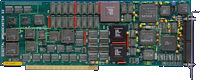
front side
- DigitalBroadCaster.pdf
User's Manual
1417 kB - DigitalBroadcaster32.pdf
User Manual
948 kB
- Broadcaster-162.dms
Install Disk
Producer v1.62 (19.01.1995), DBCFileSystem v2.6 (06.07.1994)
627 kB - Broadcaster-Anims162.dms
Animations and Documentation Disk
695 kB - Broadcaster-175.dms
Install Disk
Producer v1.75 (20.05.1995), F2J v1.1 (09.05.1995), DBCFileSystem 2.8 (10.03.1995)
628 kB - Broadcaster-177.dms
Install Disk
Producer v1.77 (23.06.1995), DBCFileSystem 2.8 (10.03.1995)
579 kB
Manufacturer Digital Micronics, USA | Date 1991 | Amiga A2000, A3000, A4000 | Interface Zorro II | Autoconfig ID 2129 / 1 |
- RTG graphics card
- Texas Instruments TMS34010 @ 60 MHz graphics processor
- up to 1280×1024 non-interlaced
- up to 2048×2048 interlaced
- 256 colours from the 16.7 million palette
- 16 colour overlay
- two hardware cursors
- up to 4 MB video RAM - 32 ZIPs
- Resolver A - 1 MB VRAM, 1024×768, without double buffering
- Resolver B - 2 MB VRAM, 1600×1200, with double buffering
- Resolver C - 4 MB VRAM, 2048×2048
- up to 1 MB overlay video RAM - 8 ZIPs
- up to 8 MB DRAM for resident applications (2 MB standard) - 16 ZIPs
- 2048×2048 can be displayed even on a Commodore 1950 monitor that is 800×600 only
- 3 BNC output connectors
- SAGE (Standard Amiga Graphics Environment) driver
- X-Windows driver for Amiga Unix System V Release 4
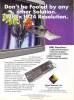
Advert (US)
1991-09
Manufacturer Applied Magic, USA | Date 1996 | Amiga A3000, A4000 | Interface Zorro III |
- developed to operate in conjunction with the Broadcaster Elite and the Broadcaster32 non-linear video editing cards
- requirements:
- Broadcaster Elite or Digital Broadcaster 32 video card
- 32 bit SCSI device (for example Phase5's Fastlane Z3)
- SuperBuster 11
- AmigaOS 3.x
- processor
- Texas Instruments TMS320C30 @ 40 MHz DSP
- 20 MIPS, 40 MFLOPS
- memory
- 256 kB SRAM audio sample memory expandable up to 4 MB with two SIMMs
- 32 kB high speed dual ported SRAM program memory
- audio support
- Crystal CS4225 16 bit audio codec (quad channel version of the CS4215)
- 16 internal 16 bit audio channels (with at least 2 MB SRAM)
- sample rates: 32, 44.1, 48 kHz
- realtime volume envelope control (i.e. no rendering)
- realtime pan control - place sound anywhere in the room
- audio effects: compression, noise gating, reverb
- audio scrubbing
- video effects support
- also serves as a transition and CG rendering accelerator
- accelerates transition rendering times to 4-10× faster over a stock A4000
- more complex transitions and video effects such as 3D page turns with realistic rendering time
- I/O
- inputs
- 2 balanced +4 dBu XLR analog inputs
- 1 (stereo pair) digital input (AES / EBU format)
- outputs
- 4 balanced +4 dBu XLR analog outputs (ie. surround capable)
- 1 (stereo pair) digital output (AES / EBU format)
- digital I/O also supports the SP/DIF standard
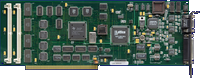
front side
Manufacturer Applied Magic, USA | Date 1997 | Amiga A3000, A4000 | Interface Zorro III |
- designed as a stand alone system or can be used in combination with the Broadcaster Elite or Video Toaster Flyer non-linear video editing cards
- requires SuperBuster 11 and AmigaOS 3.x
- processor
- Texas Instruments TMS320C30 @ 40 MHz DSP
- 20 MIPS, 40 MFLOPS
- memory
- 256 kB SRAM audio sample memory expandable up to 4 MB with two SIMMs
- 32 kB high speed dual ported SRAM program memory
- audio support
- uses separate 20 bit D/A and A/D converters rather than a combined 16 bit codec
- Crystal CS4329 D/A converter, 112 dB signal to noise ratio
- Crystal CS5390 A/D converter, 107 dB signal to noise ratio
- true quad output
- full volume and panning control over all channels
- full range functions on up to 16 track quad at the same time
- optional SMPTE timecode
- I/O
- 4 balanced +4 dBu XLR analog inputs and outputs
- 1 (stereo pair) digital input and output (AES / EBU format)
- digital I/O also supports the SP/DIF standard
- software
- ProducerAUDIO
- AudioLab 16
Manufacturer Digital Micronics, USA | Date 1992 | Amiga A3000, A4000 | Interface Zorro III | Autoconfig ID 2129 / 2 |
- rendering engine
- TMS 34020 @ 40 MHz graphics processor
- up to 2048×2048 interlaced resolution in 24 bit
- up to 1280×1024 non-interlaced
- 32 bit pixel depth (including 8 bit alpha channel)
- up to four TMS 34082 coprocessors (optional)
- 32 bit math / graphics coprocessor
- 3D vector support and rendering engine
- parallel processing capability
- 40 MFLOPS per piece - 160 MFLOPS total
- 25,000 shaded polygons per second - 100,000 total
- 512 kB static RAM per coprocessor
- up to 16 MB video RAM (4 MB standard)
- 4 MB: 1024×1024 non-interlaced, 1024×1024 interlaced
- 8 MB: 1280×1024 non-interlaced, 1600×1280 interlaced
- 12 MB: 1280×1024 non-interlaced, 2048×1536 interlaced
- 16 MB: 1280×1024 non-interlaced, 2048×2048 interlaced
- the video memory can also be used as system memory by the Amiga
- up to 8 MB DRAM for resident applications (4 MB standard)
- upgrade modules:
- single graphics math coprocessor upgrade kit (1× TMS 34082) with 128 kB of 32 bit static RAM module (max. 2 per board)
- double graphics math coprocessor upgrade kit (2× TMS 34082) with 256 kB of 32 bit static RAM module (max. 1 per board)
- video memory upgrade kit - 4 MB VRAM (max. 4× per board or 3× with video encoder module)
- program memory upgrade kit - 4 MB DRAM
- broadcast quality digital video encoder (NTSC, PAL, SVHS)
- allows high resolution graphics to be taken directly to video tape retaining their broadcast quality
- supports NTSC or PAL and SVHS
- genlocks the Vivid 24 using either a sync generator or any external video source
- plugs into the same location as a video memory module
- video effects generator (for use with the video encoder module)
- provides input for two video sources
- special effects
- allows the mixing of both sources based on the Vivid 24 computer generated graphics
- SAGE (Standard Amiga Graphics Environment) driver
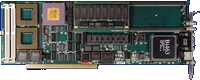
front side
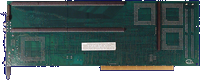
back side
- Vivid24.dms
Install Disk
sage.library v36.2 (1.5.1992), vivid.library Vivid 38.4 (16.7.93), Vivid24 Tweek v1.04
531 kB